Introduction
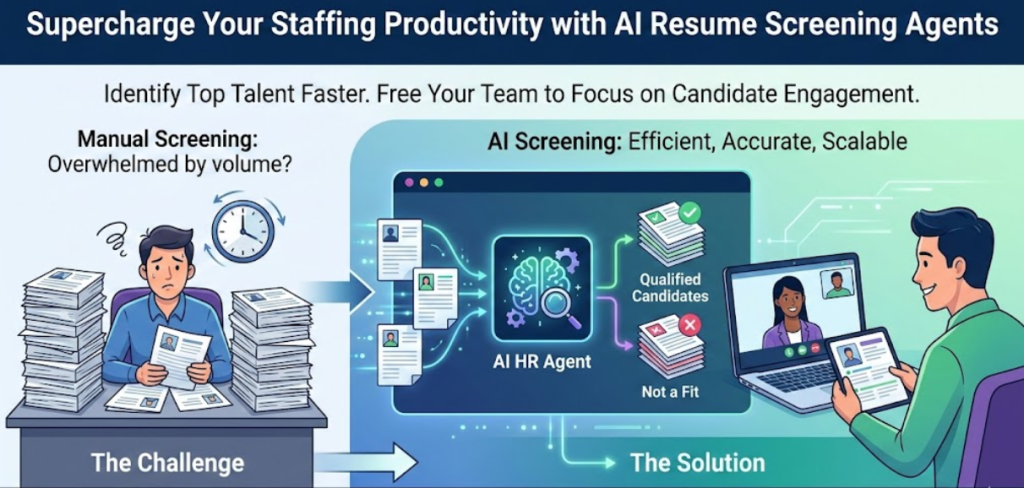
In the staffing world, speed-to-deliver (fill a client’s role fast) and candidate experience matter as much as the quality of hire. AI-powered resume screening agents can dramatically increase recruiter productivity, shorten time-to-fill across multiple client orders, and improve consistency—without sacrificing governance or compliance. This post explains how AI resume screening works for staffing firms, the benefits, best practices, and a practical implementation path.
Section 1: How AI Resume Screening Works
- AI resume screening uses natural language processing and machine learning to parse resumes, extract skills, experience, and qualifications, and compare them to client-specific job requirements.
- It can score and rank candidates, automate screening tasks, and trigger candidate communications or scheduling, all while maintaining an auditable trail for compliance.
- Keywords: AI in recruitment, resume screening automation, candidate ranking, NLP in hiring, multi-client screening.
Section 2: Productivity Benefits for Staffing Firms
- Speed and scale: automatic triage of large applicant pools across many clients frees up recruiters to engage with top talent and manage more job orders.
- Consistency across accounts: standardized criteria reduce variability in screening decisions across offices and teams.
- Client-facing value: faster time-to-fill supports SLA adherence and improves client satisfaction and retention.
- Candidate experience: timely updates and faster next steps improve engagement.
- Scalability: easily handles spikes in applications for health care, IT, manufacturing, and other high-volume sectors.
- Keywords: time-to-hire reduction, hiring automation, recruitment productivity, candidate experience, MSP/VMS.
Section 3: Use Cases and Scenarios
- High-volume staffing: healthcare, retail, contact center, and logistics that require rapid screening at scale.
- Role-based screening: align resumes with competency models and job families used by multiple clients.
- Hard-to-find skills: quickly filter for niche qualifications to speed sourcing and shortlists.
- MSP/VMS alignment: support multi-client environments with client-specific rules and auditable trails.
- Keywords: high-volume hiring, skills matching, role-based screening, niche skills, MSP/VMS.
Section 4: Best Practices and Governance
- Human-in-the-loop: AI handles basics; a human reviewer confirms final decisions for each client and requisition.
- Transparent scoring rubrics: tie scoring to job requirements and measurable outcomes for each client.
- Bias mitigation and fairness: test models with diverse data, monitor for disparate impact, and perform periodic audits.
- Privacy and compliance: ensure data handling aligns with EEOC guidelines and regional privacy laws; maintain separate data controls for each client.
- KPI tracking: measure time-to-screen, time-to-fill, client satisfaction, and candidate experience.
- Keywords: bias in hiring, human-in-the-loop, compliance in hiring, audit trails, data governance.
Section 5: Implementation Roadmap
- Discover and scope: map high-volume client accounts and their screening criteria.
- Data readiness: ensure client job descriptions and resumes are clean, standardized, and aligned.
- Tool selection and integration: choose AI screening tools with explainability and multi-tenant governance; integrate with ATS/VMS and CRM.
- Pilot and iterate: run a controlled pilot with 2–3 clients, gather recruiter feedback, and refine scoring rules.
- Scale and monitor: expand gradually, with ongoing bias checks, governance reviews, and performance audits.
- Keywords: AI in HR tech, recruitment automation, vendor selection, pilot programs, multi-tenant architecture.
Section 6: Risks and How to Mitigate Them
- Bias and transparency gaps: mitigation via bias testing, explainable AI features, and human oversight.
- Data privacy and client data separation: robust data governance, role-based access, and per-client data isolation.
- Over-reliance on automation: maintain explicit criteria for final hires and ensure clients’ SLAs are met with human review where needed.
- Keywords: bias in hiring, explainable AI, data governance, privacy in HR technology.
Section 7: Metrics to Track for ROI
- Time-to-screen, time-to-fill, and candidate-to-client handoffs.
- Client-facing metrics: fill rate by client, SLA adherence, and client NPS.
- Recruiter productivity: deals closed per recruiter, engagement quality, and gross margin per requisition.
- Candidate experience: satisfaction scores and offer rates.
- Keywords: time-to-hire, cost-per-hire, quality-of-hire, candidate experience, recruiter productivity, client satisfaction, MSP performance.
Conclusion
AI-powered resume screening can be a strategic amplifier for staffing firms, enabling faster fills, consistent quality across multiple clients, and better candidate experiences—when paired with clear criteria, governance, and human oversight.
What has your staffing firm learned when adopting AI in resume screening? Share your KPI targets, a success story, or a challenge you’re aiming to solve.
Ask for AI HR agent Demo for your staffing needs contact@aiworx.cloud
Leave a Reply